What you'll learn
- How a picture model turns words into a picture, in plain words
- How to describe a picture so you get what you imagined
- Why one fixed style makes all your pictures look like a family
- Which picture models Cloudflare has, and what each picture costs
- How one picture is shown at the right size on every screen
- What AI can do with video, voices and text, with real examples
The pictures, the voice clips and the AI answers were all made with Cloudflare's AI models on 19 November 2026, for this course. Nothing is mocked up.
How it works
How a picture model works, how to describe a picture, and why style matters.
How a picture model works
A picture model learned by looking at millions of pictures, each with a short description. Over time it learned which shapes and colours go with which words: what "cat", "sunset" or "watercolour" tends to look like.
When you ask for a picture, it does something surprising: it starts from pure noise, like the static on an old TV. Then, step by step, it removes a little of the noise, each time nudging the speckles towards something that matches your words. After 20 to 30 small steps, a clear picture is left.
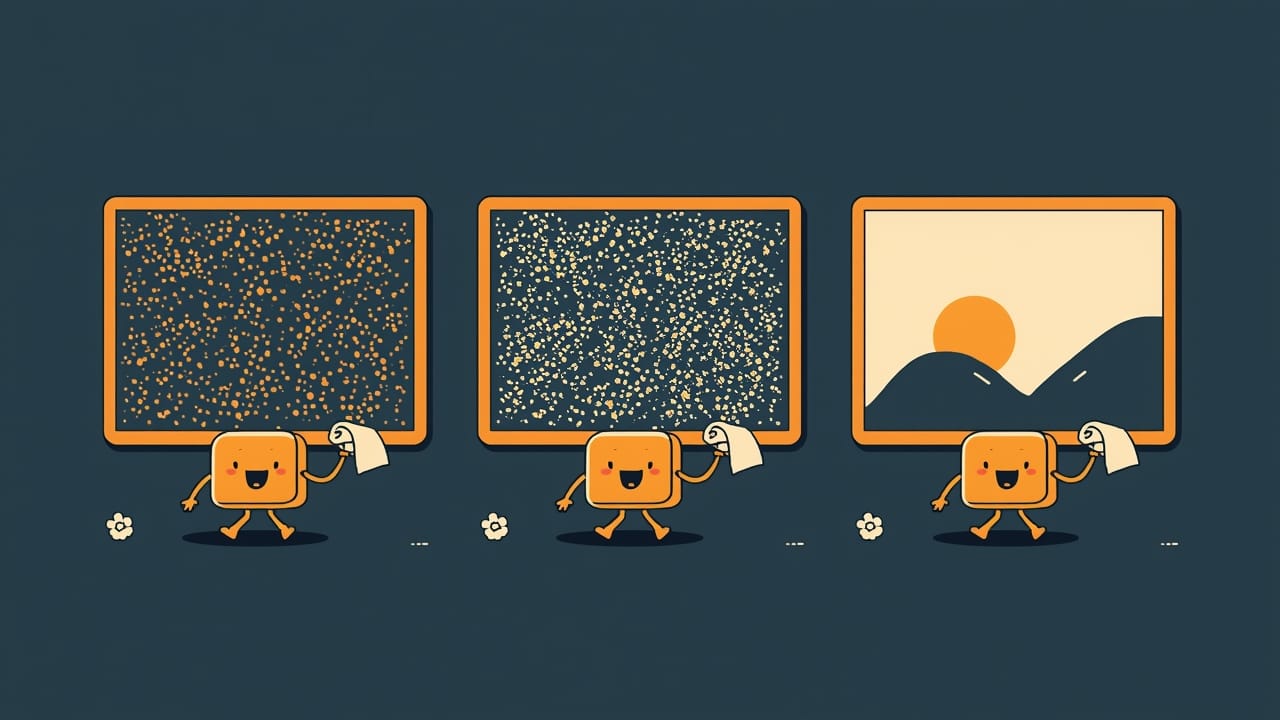
A sculptor starts with a rough block of stone and chips away everything that isn't the statue. A picture model starts with a block of noise and wipes away everything that doesn't match your description.
🔁 Steps
How many clean-up rounds the model does. More steps usually means more detail, but takes longer and costs a little more. Our pictures used 25.
🎲 Seed
The number that decides the starting noise. Same words and same seed give almost the same picture again. A new seed gives a new variation of the same idea.
The model learned what writing looks like, not how to spell. That's why small text in AI pictures often comes out as made-up letters. Our rule: ask for no text in the picture, and put words on the page instead.
Describing a picture
The model only knows what you tell it. Everything you leave out, it guesses. These three real pictures were made with the same model and the same seed. Only the description changed:

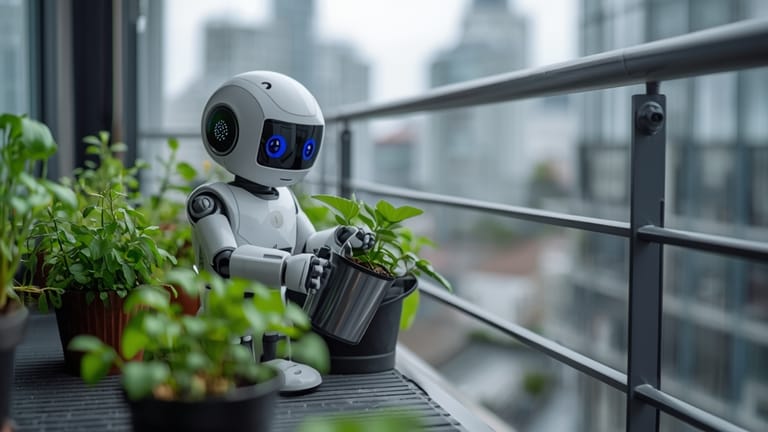

A good description is like a recipe. Go through these ingredients, roughly in this order:
- Who or what: the main subject (a small friendly robot)
- Doing what: the action (watering tomato plants)
- Where and when: the setting and time (a sunny balcony, in the morning)
- Look: the style (flat cartoon, watercolour, photo)
- Colours and light: (navy and amber, soft warm light)
- Mood and framing: (calm, seen from the side, lots of empty space)
- What to leave out: (no text)
Practise: build your own description. Pick at least one ingredient from five different rows and watch the recipe grow.
Why a fixed style matters
If you only describe the subject, the model picks a different look every time. Here are three real pictures made from plain, short descriptions:
Without a fixed style

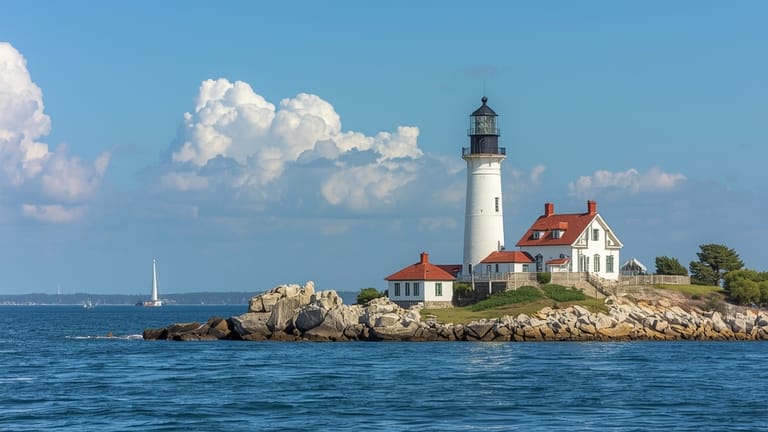

Each one is nice on its own, but next to each other they look like they come from three different websites. Now the same three descriptions, each with our house style sentence added:
With our fixed house style



Now they belong together. That's what your course site does: every picture uses the same style sentence, so all covers and lesson pictures look like one family. This is the exact sentence added to every picture:
A team in the same shirts looks like a team, even if everyone is different. A fixed style is your pictures' uniform: the subject changes, the look stays.
Practise: does each piece belong in the style sentence (the same for every picture) or in the description (different for each picture)?
Models and costs
Which model, what it costs, and one picture for every screen.
Which picture model?
Cloudflare runs several picture models on its own computers (this group is called Workers AI). They differ in quality, speed and price. Prices below are for one picture of 1280 × 720 pixels, worked out from Cloudflare's official price list:
| Model | Made by | Good for | About per picture |
|---|---|---|---|
| FLUX.1 schnell | Black Forest Labs | Fast, cheap everyday pictures | $0.0007 |
| FLUX.2 klein 4B | Black Forest Labs | Very fast, can also edit pictures | $0.002 |
| FLUX.2 klein 9B | Black Forest Labs | Better quality, can edit pictures | $0.015 |
| Phoenix 1.0 | Leonardo | Follows descriptions closely, neat text | $0.04 |
| Lucid Origin ✓ ours | Leonardo | Most polished, follows descriptions best | $0.045 |
| FLUX.2 dev | Black Forest Labs | Most realistic, slowest | about $0.06 |
It follows a long description most faithfully, and it keeps our house style steady from picture to picture. At about 4.5 cents a picture, a whole course's pictures cost around 25 to 50 cents.
Cloudflare also has a bigger model catalogue that passes requests on to other companies' models, such as Google's Nano Banana or OpenAI's GPT Image. Those are paid at each company's own price. For a learning site, Cloudflare's own models are plenty.
What it costs
Cloudflare measures AI work in neurons: a small unit of computer effort. A bigger picture or a fancier model uses more neurons.
- Every account gets 10,000 neurons free every day. The free amount resets at midnight (UTC, which is 10 am in Brisbane).
- Above that, on the $5 Workers Paid plan, it costs $0.011 per 1,000 neurons.
- On the free plan, AI simply stops for the day when the free amount is used up. There's never a surprise bill.
Practise: choose a model and how many pictures you'd make in a day. Try at least two models.
One picture, every screen
A phone doesn't need a picture as big as a desktop screen does. Sending the big one anyway makes pages slow, especially on mobile data.
Image transformations fix that. You keep one original of each picture. When someone opens a page, Cloudflare makes a copy that fits their screen, in the lightest format their browser understands, and keeps it ready for the next visitor.

Practise: pick a screen and see the real size Cloudflare sends for one of your course covers. Try all three.
✅ Free amount
5,000 different versions a month (a version is one picture at one width). Your whole site uses about 150. Formats don't count extra.
🛡️ Going over
Never costs money. Versions already made keep working; new ones simply aren't made until next month.
Beyond pictures
Video, voice and text, and what we did today.
Beyond pictures: video, voice, text
The same idea (describe what you want, get it back from a model) works for more than pictures. Here's what Cloudflare's models can do in November 2026, with real examples made for this page.

🗣️ Text to voice
Model: Aura-2 by Deepgram, with 40 English voices. Price: $0.03 per 1,000 characters, so the sentence below cost about a third of a cent. Press play:
👂 Voice to text
Model: Whisper large v3 turbo by OpenAI. Price: $0.0005 per minute of audio. We played Luna's clip back to it:
Word for word right. Only the punctuation changed slightly. Handy for turning voice notes or videos into text.
📝 Summing up text
Model: Llama 4 Scout by Meta. Price: $0.27 per million word-pieces in, $0.85 out. A "word-piece" (token) is about three-quarters of a word, so this example cost a tiny fraction of a cent.
🌍 Translating
Model: M2M100 by Meta, about 100 languages. Price: $0.34 per million word-pieces.
The Spanish is natural. The German is understandable but a bit clumsy. Always have a native speaker check important translations.
👁️ Describing a picture
Llama 4 Scout can also look at pictures. We showed it the robot picture from Lesson 02 and asked it to describe it for someone who can't see it:
Useful for writing picture descriptions for people who use screen readers.
🎬 Video
Cloudflare doesn't run video-making models on its own computers. Its wider model catalogue passes requests on to other companies, such as Google Veo 3.1, Kling, Runway, ByteDance Seedance and Wan. Each sets its own price, usually per second of video and far more than a picture, so Claude checks the price with you first.
To store and play a finished video, Cloudflare has a different service, Stream. That's covered in the Cloudflare course.
🧠 The newest text models
For writing, coding and thinking, these are among the newest models on Cloudflare (price per million word-pieces in / out):
| Model | Good for | Price in / out | Plan |
|---|---|---|---|
| Kimi K2.7 Code | Coding, tools, can also see pictures | $0.95 / $4.00 | $5 plan |
| GLM 5.3 | Long, multi-step jobs | $1.40 / $4.40 | $5 plan |
| DeepSeek V4 Pro | Careful reasoning, very long texts | $1.32 / $3.96 | $5 plan |
| gpt-oss-120b | Good all-rounder by OpenAI | $0.35 / $0.75 | Free plan too |
| Llama 4 Scout | Text and pictures, cheap | $0.27 / $0.85 | Free plan too |
Cloudflare's own models don't make music or sound effects yet. Its catalogue passes those on to other companies, such as ElevenLabs or Google Lyria, at their own prices.
What we did today
Everything in this course happened on your own site on 19 November 2026. Here's the whole day, step by step:
- 🧪A first test pictureClaude checked that your Cloudflare account could make pictures, and made a waving amber mascot for free.
free - 💳You switched on the $5 Workers planSo you could use better models, and other Cloudflare services later.
$5 a month - 🎨20 test covers, 20 stylesMade five at a time in about a minute. You picked the mascot style.
about $0.90 - 👥Five helpers, five coursesOne Claude helper per course read the lessons, made a cover plus pictures where they help, checked each one and redid the poor ones.
56 pictures, about $2.50 - 🔎Search-engine check and company footerDescriptions for Google, link previews, a page list for search engines, and a footer saying you're part of Prompt It Yourself.
free - 📐Image transformations switched onA course cover went from 279 KB to 9 KB on phones.
free - 📚This courseWritten after checking Cloudflare's documentation, with real pictures, voices and text made for it.
about $0.70
Check yourself
What would you do? Then the cheat sheet.
What would you do?
Pick the best answer for each situation.
Cheat sheet and prices
A good picture description
- Who / what
- the main subject
- Doing
- the action
- Where, when
- setting and time
- Look
- cartoon, watercolour, photo
- Colours, light
- palette and lighting
- Mood, framing
- feeling and camera angle
- Leave out
- "no text"
Words in this course
- Noise
- random speckles a picture starts from
- Steps
- clean-up rounds, about 25
- Seed
- the number behind the starting noise
- House style
- one style sentence for every picture
- Neurons
- Cloudflare's unit for AI work
- Token
- about ¾ of a word
- Transformation
- one size of one picture
Free amounts
- Workers AI
- 10,000 neurons a day
- Image versions
- 5,000 a month
- Pictures (schnell)
- about 150 a day free
- Pictures (Lucid)
- about 2 a day free
Prices (Nov 2026)
- Beyond free
- $0.011 per 1,000 neurons
- Lucid Origin
- about $0.045 a picture
- Voice (Aura-2)
- $0.03 per 1,000 characters
- Voice to text
- $0.0005 a minute
- Workers Paid
- $5 a month
Who owns the pictures I make?
You can use the pictures from Cloudflare's own models for your site. Each model has its own licence terms, so for anything commercial or printed, ask Claude to check the model's licence first.
Why did a picture come out with strange letters?
Models draw what writing looks like but can't spell reliably. Ask for "no text" and put words on the page instead. If letters still appear, make it again with a different seed.
Can I get the same picture again?
Mostly, yes: same model, same description, same size and same seed give almost the same picture. Change the seed for a fresh variation.
Do I need to make pictures in different sizes for phones?
No. Make one picture at a good size. Image transformations make the phone, laptop and big-screen versions automatically.
Will Claude make pictures for new courses by itself?
Yes. That's now a fixed rule for your site: every new course gets a cover and helpful lesson pictures in the house style, plus a search-engine check, before it goes online.